Item in the news
Coronation Street parties
But with no Bette Lynch
A land of abandoned ephemera rediscovered

Item in the news
Coronation Street parties
But with no Bette Lynch

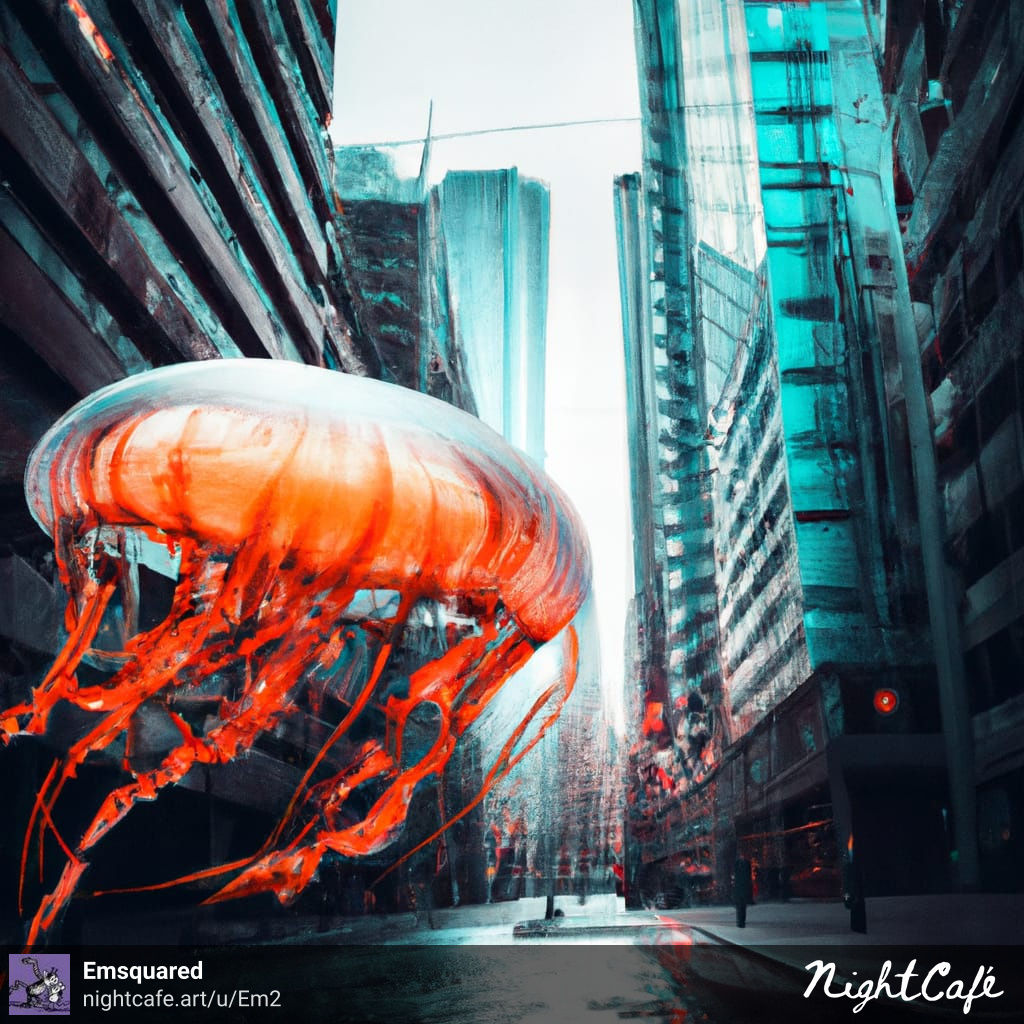
Not just a great invented band name but the basis of my own dabbling in the world of AI art. Late to the party or what?
It’s true to say that Twitter diluted my blogging output.
The lure of social media took me by the hand, pulled out my fingernails and crushed my fingers whilst I was intoxicated by b the smell of freshly baking bread.
I’m only human after all (well in part at least). Now Facebook is laying off staff, Twitter is in a state of flux and suddenly the non commercial Mastodon is seen as a place for worried Twitter types to jump onto.
In real terms the number of people suddenly signing up to Mastodon is only around 1/250th of the total number of existing Twitter users and some will find the idea of a non corporate distributed server setup struggling to cope with a sudden surge in use very confusing.
I get the feeling that social media might be on the verge of a decline or at least a fragmentation. More choice is good. Hiding in our our niche bubbles might be an act of self preservation.
We shall see.

Where is my head at these days?
I guess most people would say it’s above your shoulders in the same way that Ringo responded to the question in The Beatles 1965 film Help!:
Lennon: “How do you feel?
Ringo: “I used to use my hands”
https://youtube.com/clip/UgkxsUjOHlCryfDoDaMlCAK4-aDxJmdXn5u6
Trouble is I’m not sure I’m very connected to my body. I’ve always lived in my head. And that was always an abstract place. Wherever you are in dreams is most definitely where I am.
If indeed there is actually an “I” (a million Buddhists punch the whilst declaring “by jove I think she’s got it”)
Certainly my mental health has declined over the past few years but then that’s always been a roller coaster.
So to answer the question as to where my head is at: it’s somewhere else. Maybe that’s a bad thing. Maybe it’s a self protection kind of thing.
Anyway wherever you are and however you are coping I wish you very well.

The pandemic has clearly impacted raw material prices. A war in Ukraine is going to push up oil and gas prices further.

In the UK energy price rises have been announced and the method of madness enacted is to apply the majority of post April 1st price rise to the daily standing charge. In my own case this is stated to rise from 21 pence per day for electricity to 47p per day.
Part of this standing charge rise is to shore up the failing energy market in the UK, to keep the illusion of competition alive after a wave of smaller energy providers have gone bust (including one medium sized company, Bulb who had over a million users and was deemed to large for the big six energy providers to absorb and so is temporarily run by the government).
The other cost is the £150 “loan” that each energy user in the UK will get off their bills this year but that will be paid back over five years (so we will all be paying back this loan in subsequent years even if energy prices rise further.Robbing Peter to pay Paul?). In effect the huge rise in standing charges will help keep energy companies afloat whereas the liquidity of their users is a secondary concern.
Putting the majority of the energy price rises on the standing charge means that even if poorer households drastically reduce their energy usage and don’t put on their heating in winter they will only save down to the now raised floor of the standing charge.

For me this means that in summer months I will be paying more in standing charges than for the energy I consume. I’m going to be paying more for using less. That’s hardly fair and presumably the cost of getting that energy to me, purely in the ongoing cost of maintaining the infrastructure has not increased by the percentage we will all now be paying come April (let alone a projected further price cap review in October).
I see now why the review of energy pricing a few years back stated that all providers should include standing charges (we were with a company that had no standing charges).
So even those using micro-generation such as solar and wind to offset what they pay for their energy will find their bills rising due to an increase in standing charges.
Only complete off-grid energy users will be unaffected.
An Xmas eve anxiety dream involving a kind of skyhook system except I had to fire a hook on a wire up from the ground to falling skydivers (why? It’s a dream. They all make sense when in the dream).
The anxiety bit is I have a team around me that wants to fire said skyhook from indoors which misses the impossibly small channel carved in the wall for this improbable exercise.
Of course the firing fails and, against the clock I have to rewind the cable onto an impossibly large reel whilst being shouted at by the others telling me we’re running out of time. The skydivers are getting lower. Why we have to hook them in is, of course, hard to fathom but ours is not to question why.
Merry Xmas on and all.
 Up the hill backwards